
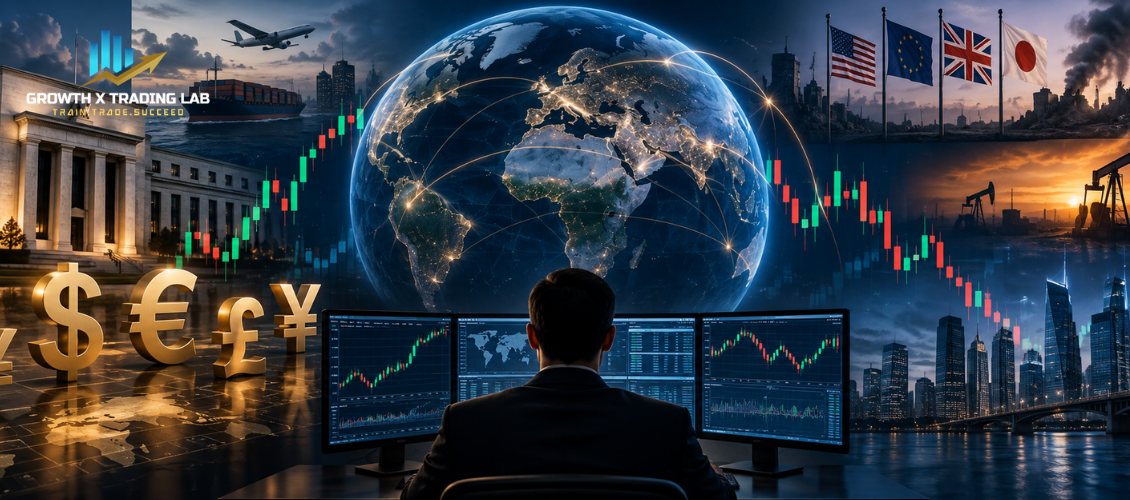
Most of the time, changes in forex aren't just chance. Economic realities, choices made by leaders, or big world events pull the strings behind the scenes. What you see on a chart only tells part of the story.
# What Really Moves a Currency? Understanding Economic Data and Global Events in Forex
A currency can move sharply within seconds—even when nothing has changed on the chart technically.
The reason often sits outside the chart.
**Inflation data, employment reports, interest-rate decisions, economic growth and geopolitical events can change how the market values one currency against another.**
Learning to understand these drivers is a fundamental part of **forex trading education**.
## Economic Data Changes Expectations
Forex traders closely monitor an **economic calendar** because scheduled data releases provide information about the health of an economy.
Some of the most closely watched indicators include:
* Consumer Price Index (CPI)
* Gross Domestic Product (GDP)
* employment and unemployment data
* Nonfarm Payrolls (NFP)
* retail sales
* manufacturing and services data
* Producer Price Index (PPI)
But a strong number does not automatically mean a currency will strengthen.
The market reaction often depends on one important factor:
**Actual result vs market expectation.**
Suppose US employment is expected to increase by 150,000 but the reported figure is 230,000. Traders may interpret the stronger result as evidence of economic resilience.
The next question becomes: **Could this change Federal Reserve policy expectations?**
That is where economic data begins influencing currency prices.
## Interest Rates Connect the Economy to Forex
Interest rates are among the most important long-term drivers of currency valuation. Higher relative rates can increase demand for a currency by making assets denominated in that currency comparatively more attractive.
This is why forex traders follow central banks such as the:
**Federal Reserve (Fed)**
**European Central Bank (ECB)**
**Bank of England (BoE)**
**Bank of Japan (BoJ)**
For example, if markets begin expecting US interest rates to remain higher while European rates are expected to fall, that changing **interest-rate differential** can influence EUR/USD.
The important lesson is to analyse both sides of a currency pair.
EUR/USD is not simply a view on the euro. It represents the relative value of the **euro against the US dollar**.
## Inflation Can Move Several Markets at Once
Inflation data such as **CPI** receives significant attention because inflation can influence central-bank decisions and future interest-rate expectations.
An unexpected inflation reading can therefore create movement across:
**Forex → Bonds → Gold → Indices → Commodities**
This explains why a trader analysing EUR/USD or GBP/USD should understand more than candlestick patterns.
A technically important price level can be broken quickly when new economic information materially changes market expectations.
## Global Events Create Unscheduled Volatility
Not every market-moving event appears on the economic calendar.
Wars, elections, trade disputes, political uncertainty, energy-supply disruptions and unexpected policy announcements can rapidly change **market sentiment and risk appetite**. Political and geopolitical developments are recognized drivers of currency demand alongside economic data and interest rates.
During periods of uncertainty, capital can move between currencies as investors reassess economic and financial risks.
Commodity prices can matter too. Large movements in oil and gold may influence currencies connected to commodity-exporting or importing economies.
## Learn the “Why” Behind the Chart
Technical analysis can help traders study **where price is moving**.
Fundamental analysis helps explain **why the market may be moving**.
A structured forex education should teach traders to connect both.
Before a trading session, ask:
**What high-impact events are scheduled today?**
**What is the market expecting?**
**Which currencies could be affected?**
**Could the data change interest-rate expectations?**
**How might volatility affect my risk and execution?**
Understanding these questions does not make market reactions perfectly predictable. It gives traders something more useful: **context**.
A chart shows the movement. Economic data, monetary policy and global events can help explain the forces behind it.
*Educational content only. Forex and leveraged trading involve significant risk. Market reactions to economic events are not guaranteed, and past relationships may not predict future movements.*