

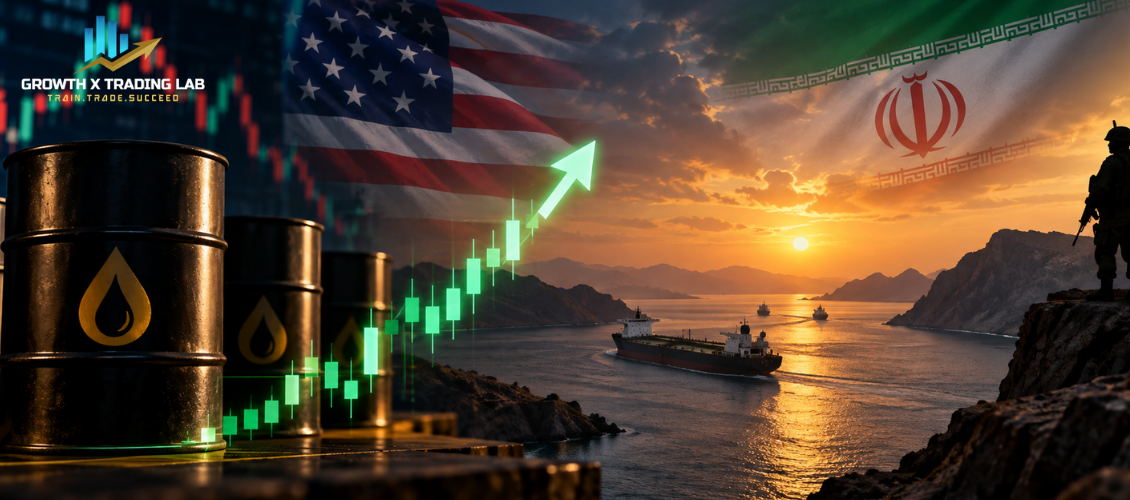
Energy markets moved sharply this week as negotiation uncertainty and shipping-lane tension pushed a familiar risk premium back into crude pricing.
Oil prices have moved higher as markets reassess the risk surrounding **U.S.–Iran relations and the Strait of Hormuz**, reminding traders that crude oil prices respond not only to current supply but also to expectations about what could disrupt supply next.
Brent crude has traded near **$97 per barrel**, with renewed tensions around shipping in the Gulf contributing to a higher geopolitical risk premium. The Strait of Hormuz remains particularly important because roughly one-fifth of global oil and LNG supplies normally pass through the route.
For traders learning **crude oil market analysis**, the current situation provides a useful example of how geopolitics can quickly become a market driver.
## Why U.S.–Iran Uncertainty Is Affecting Oil
Oil markets continuously price future supply expectations.
When negotiations appear likely to reduce tensions, traders may expect shipping conditions and energy flows to improve. When negotiations stall or the probability of further confrontation increases, the market may begin pricing a greater risk of disruption.
This additional amount embedded in the oil price is often described as a **geopolitical risk premium**.
Importantly, oil does not need to disappear from the market completely for prices to react. The possibility of future disruption can be enough to change sentiment.
That is why traders should distinguish between:
**Actual supply disruption** — physical oil availability has been reduced.
**Supply risk** — the market believes disruption could become more severe.
Understanding the difference is important when analysing short-term movements in **Brent crude and WTI crude oil**.
## Why the Strait of Hormuz Matters
The Strait of Hormuz is one of the world's most important energy transit routes.
Recent developments have increased attention on vessel movements through the region. Iran has announced plans for a new restricted zone in the Gulf and a proposed shipping corridor through the Strait, while tanker traffic has already been affected by heightened tensions.
For the oil market, disruption around Hormuz can affect more than crude production itself.
Reduced shipping reliability can potentially influence:
* transportation costs
* tanker availability
* insurance costs
* delivery schedules
* regional crude exports
* expectations for global supply
This is why traders following oil should monitor **shipping activity and physical supply conditions**, not simply geopolitical headlines.
## What Should Oil Traders Watch Next?
The next direction in crude oil may depend on whether geopolitical risk develops into a more persistent physical supply problem.
Traders can monitor **U.S.–Iran negotiations, Strait of Hormuz shipping flows, crude oil inventories, OPEC+ production decisions and global demand conditions**.
Current conditions also demonstrate why crude oil trading requires both technical and fundamental analysis.
A chart can show where price is moving.
Fundamental analysis can help explain **why the market is repricing**.
For students learning commodity trading, this distinction is essential. Geopolitical headlines can create short-term volatility, but sustainable price trends usually require traders to examine how those events affect actual supply, demand and market expectations.
## The Learning Point
The current oil market provides a practical lesson in how financial markets process uncertainty.
Oil prices do not wait for a supply disruption to be officially confirmed. Markets can begin adjusting as soon as traders believe the probability of disruption has changed.
This is why professional **oil market analysis** goes beyond asking whether a headline is positive or negative.
A more useful question is:
**Does this development materially change expectations for global oil supply, demand or transportation?**
Learning to make that distinction can help traders interpret movements in **Brent crude, WTI crude oil and the wider commodities market** with greater context rather than reacting to headlines alone.
*Disclaimer: This material is provided for educational and market-awareness purposes only. It does not constitute investment advice or a recommendation to buy or sell any financial instrument. Commodity and leveraged trading involve significant risk.*