

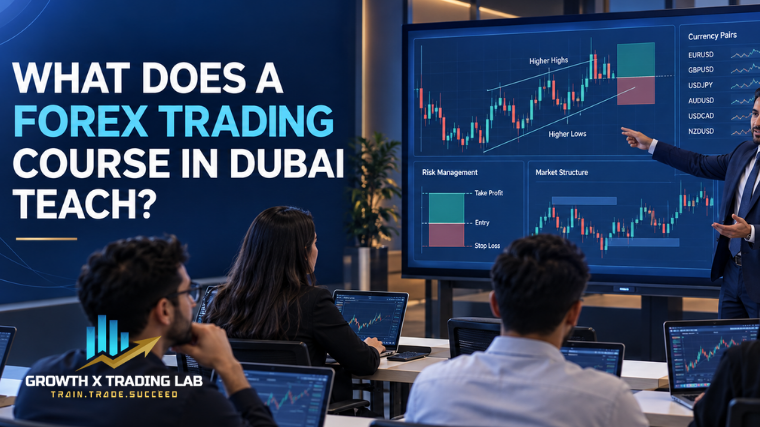
A well-structured forex trading course in Dubai should teach how the market functions, how to analyze price behaviour, how to control risk, and how to practice a repeatable trading process. It should not be limited to memorizing chart patterns or copying another trader’s entries.
Beginner instruction normally starts with currency pairs, bid and ask prices, pips, spreads, lot sizes, leverage, and margin. These concepts explain how trades are priced and how exposure is created. Students should be able to calculate approximate risk before progressing to strategy-based lessons.
Platform training is another essential component. Learners need to understand how to read a quote, open and close positions, use market and pending orders, place a stop loss, and review their trading history. Platform familiarity is not the same as trading skill, but it is necessary for accurate execution.
Technical analysis lessons may cover trends, support and resistance, candlestick behaviour, market structure, momentum and price action. These subjects should be taught as tools for building scenarios—not as signals that predict every market movement.
A complete curriculum should also introduce fundamental analysis. Interest-rate decisions, employment data, inflation reports, and central-bank communication can change volatility and market expectations. Students do not need to become economists, but they should understand why economic events matter and when risk may be unusually high.
Risk management should run through the entire course. This includes position sizing, stop-loss placement, risk-to-reward assessment, drawdown control, and maximum exposure. Students should learn that a valid setup can still lose and that one outcome does not prove whether a decision was good or bad.
Trading psychology is equally important. A forex trading course should address overtrading, revenge trading, fear of missing out, hesitation, and inconsistent rule-following. Journaling and structured reviews can help students identify these behaviours.
The practical stage should involve chart exercises, simulated trading, scenario planning, and feedback. Learners should gradually move from recognizing concepts to explaining and applying them independently.
When comparing a forex trading academy in Dubai, examine the complete curriculum rather than focusing only on advertised strategies. Quality education should build independent decision-making, realistic expectations, and respect for market risk.