

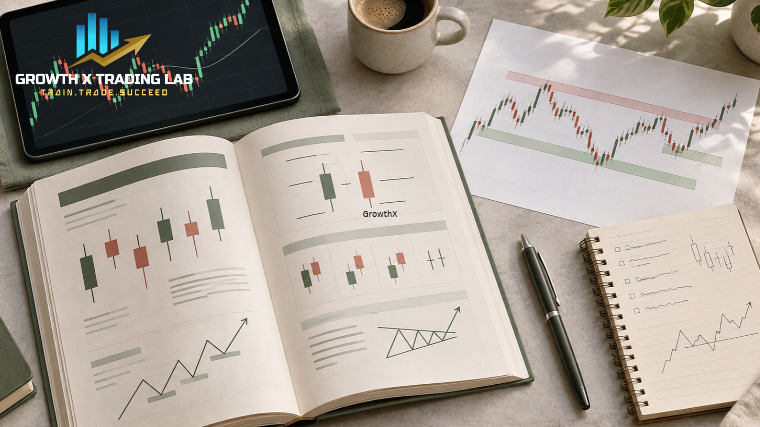
A beginner forex course should help you understand how the market and trading tools work. It should also give you a chance to apply the concepts in practice. Before choosing a course, check the curriculum and make sure it covers the basics, not only trading strategies.
- Currency pairs and forex terminology
Start with how currency pairs are quoted and what it means to buy or sell a pair. A course should explain key terms such as pip, spread, lot size, margin, and leverage in simple language. These ideas help you understand how a trade is measured and what may affect its costs and risks.
- Candlesticks and market structure
Candlestick charts show price changes over a selected period. Beginners should learn how to read the open, high, low, and close, and how to describe basic price movement. Market structure lessons can introduce trends, swing highs and lows, and areas where price has previously reacted.
The aim is to learn how to analyze a chart consistently, not to treat any chart pattern as a guaranteed signal.
- Trading platforms and order types
A beginner should know how to navigate a trading platform, select an instrument, view a chart, and understand common order types. Practice in a demo environment can help you learn the interface without risking real money.
- Risk management
A course should explain how position size, stop-loss orders and leverage relate to potential losses. It should encourage students to make decisions within their own financial limits and to understand that a stop-loss does not remove all risk.
Risk management should be taught alongside chart analysis, not as an afterthought.
- Practice and review
Practical learning gives students a chance to apply theory to charts and review their decisions. A journal can help record the reasoning behind a practice trade, the result, and any lessons to revisit.
GrowthX lists its Forex Kickstarter as a beginner-to-intermediate program with 10 hours of theory and 30 hours of practical learning. Its listed topics include candlestick learning, price action, market structure, platform and order types, and introductory risk management. See the GrowthX course page for current program details and fees.
Questions to ask before enrolling
Ask what topics are included, how much practical learning is provided, what support students receive, and whether the course explains the risks of trading. Compare the full curriculum and fees before deciding.
A good beginner forex course should help you build knowledge and practice a process. No course can guarantee trading profits, and trading may result in losses.